
Yoga Teacher Training Abroad: How to Choose the Right Program

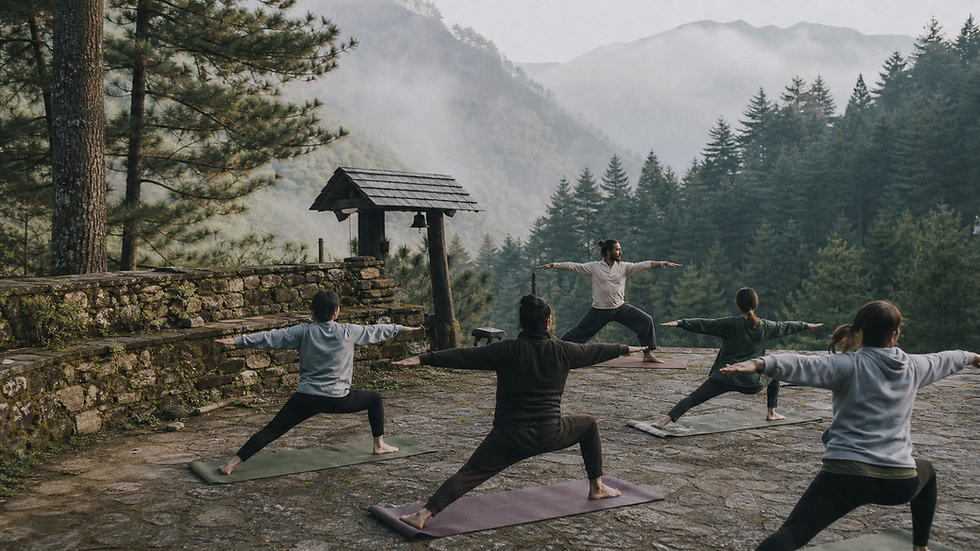
A yoga teacher training abroad is a full immersion program held in a foreign country, usually between 14 and 28 days, designed to support a depth of study that a part-time local program rarely provides. What makes one worth crossing an ocean for has less to do with the location itself and more to do with what the program chooses to do with the time it has.
Most people who search for a yoga teacher training abroad have already decided they want to leave.
The question they are not asking out loud is:
Leave what?
That question matters. Not because a teacher training should become therapy, but because the honest answer tells you something about what you actually need from the training.
A program that runs in a resort in a warm country with good Instagram aesthetics is a real option.
So is a program that asks more of you than that.
Knowing which one you need before you pay the deposit saves a significant amount of disappointment.
What You Are Actually Looking For
The Yoga Alliance 200-hour certification is the same credential wherever it is awarded. A registered yoga school in Bali, Mexico, Costa Rica, India, or your home city produces the same basic letters after your name.
The piece of paper is not the reason to go abroad.
What changes when you leave is the container.
An immersion in a foreign country removes the ordinary infrastructure of your life: the commute, the evening plans, the social obligations, the ten things you were going to do after class. That removal is not incidental.
It is the point.
The training works because your attention has nowhere else to go.
This is worth naming clearly before choosing a program, because the benefit is available or wasted depending on how the program is designed.
Some programs lean into the immersion: early mornings, sustained practice, teaching that continues in the evening, meals shared in community, silence, study, teaching labs, philosophy, embodiment, and reflection.
Others deliver the required curriculum over the smallest possible number of days, leave the rest of the process unintegrated, and hope the location does the spiritual heavy lifting.
Both may technically produce a certificate.
They do not produce the same kind of teacher.
For a clearer picture of what a 200-hour yoga teacher training actually involves, that piece covers the curriculum structure and what you should expect to leave knowing.
More info about our Embodied Awakening 200Hr Yoga and Embodiment Teacher Training here.
Be Careful With Very Short 200-Hour Trainings
Some yoga teacher trainings abroad are marketed as 200-hour programs completed in as little as 14 days.
This is where students should pay attention.
A 200-hour yoga teacher training is supposed to include, unsurprisingly, 200 hours of training. Yoga Alliance describes the RYS 200 as a foundational 200-hour training covering essential techniques, anatomy, philosophy, and professional development. Yoga Alliance also states that Registered Yoga School programs may count no more than 14 instructional hours per day.
Do the maths.
Fourteen days multiplied by fourteen hours per day is 196 hours.
That is already less than 200.
And that is assuming 14 full instructional hours every single day, with no real breaks, no softer integration time, no fatigue, no digestion, no human nervous system, no one wondering why they paid to be spiritually pressure-cooked in leggings.
So if a training claims to deliver a full 200-hour certification in 14 days, something else has to be happening.
Maybe there are online sessions before or after the in-person training.
Maybe there are recorded lectures.
Maybe there are self-study modules.
Maybe there is a self-assessed practicum after the residential portion.
Maybe homework and assignments are being counted toward the total.
Some of that can be legitimate if it is clearly explained.
But if the marketing makes it sound like you are receiving a complete, embodied, in-person 200-hour training in 14 days, you should ask very direct questions.
How many live contact hours are actually included?
How many hours are with the lead teacher?
How much is online?
How much is self-study?
How is teaching practice assessed?
How many actual classes will you teach?
How much feedback will you receive?
Will you leave having actually taught, or only having imagined yourself teaching in a PDF?
This is not nitpicking.
It is the difference between training and administrative magic.
A compressed program may be convenient. It may even be appropriate for someone with a strong existing practice and limited time. But convenience is not the same as depth.
At Hridaya Family, our training includes more than 200 hours of live class time. The schedule is not padded with vague self-study, imaginary integration, or “please watch these videos after you go home and call it embodiment.” The immersion itself carries the weight of the training.
That matters.
Because yoga is learned through repetition, contact, correction, reflection, practice, and time.
Not just content delivery.
21 Days vs 28 Days: What the Extra Week Actually Changes
This comparison comes up often.
Most serious residential 200-hour programs run between 21 and 28 days. Some are shorter, but as we have just said, very short formats usually rely on online material, self-study, or post-training assignments to complete the hours.
The difference between 21 and 28 days is real, but it is not primarily about extra curriculum content.
It is about digestion.
In a 21-day program, the schedule is compressed. Most days will be full. There is enough time to absorb the material and begin to apply it. What is harder to fit in is the slower process of things settling.
The first week of any immersion is largely adjustment: new altitude, new food, new schedule, new people, new rhythm, new expectations.
The second week is where the practice begins to deepen.
The third week is where the student starts to understand that yoga teacher training is not only about learning information. It is about being changed by the way the practice, philosophy, and teaching methodology begin to reorganise perception.
In a 21-day program, you often leave just as that deeper process is beginning to stabilise.
In a 28-day program, there is a fourth week.
That fourth week is where integration happens.
The teaching that was still intellectual in week two becomes something closer to embodied knowing by week four. Students begin to teach from a different place. They are less busy performing competence and more capable of feeling the room, sensing their own body, speaking from actual contact, and understanding the practice as something lived rather than something memorised.
Students who have experienced longer immersion consistently describe the fourth week as qualitatively different from the first three, not because the content suddenly becomes more advanced, but because the student has changed enough to meet it differently.
Neither format is universally better.
If you are coming to a teacher training with an established practice and clear intentions, 21 days can be sufficient.
If you are new to immersive study, or if the training is also serving a personal transition of some kind, 28 days is usually the more honest choice.
Why the Location Matters More Than the Weather
The destinations that dominate the yoga teacher training market abroad tend to be Bali, India, Mexico, Costa Rica, Thailand, and sometimes Guatemala or Nepal. The selection is often made on the basis of cost, climate, convenience, and how beautiful the photos look when someone is pretending not to pose.
Those things matter.
But not as much as people think.
The deeper question is not:
Where would I like to spend a month?
The deeper question is:
What kind of environment will support the kind of transformation I am actually asking for?
San Cristóbal de las Casas in the highlands of Chiapas is unusual in the yoga teacher training abroad market.
It is not a beach town.
It is not a resort bubble.
It is a colonial highland city at around 2,200 metres, cold in the mornings, surrounded by pine forest, with a living Indigenous Tzotzil and Tzeltal presence that has not been smoothed over for tourist consumption.
It is not easy in the way a resort town is easy.
It asks you to pay attention.
For a teacher training, that quality is useful.
The practice of sustained attention is, in one sense, the entire content of the training. A setting that models it from the outside supports it from the inside.
At altitude, the body has to breathe differently.
In the cold mornings, practice requires commitment.
In the forest, attention gathers.
In a real city, the practice has to land in actual life, not just inside a polished wellness fantasy.
What the San Cristóbal setting specifically contributes to the practice is covered in more detail in the Mexico post, including altitude, climate, and how the city itself functions as part of the container.
What Differentiates a Serious Program
A 200-hour curriculum has defined minimum requirements set by Yoga Alliance. Every registered program must cover them.
The differentiation is in what the program emphasises beyond the minimum, how honestly it counts its hours, and what the teaching lineage actually is.
Programs rooted in a serious philosophical tradition will teach differently than programs assembled from contemporary wellness influences.
Neither is automatically fraudulent.
But they produce different kinds of teachers.
A training that treats yoga primarily as posture, sequencing, branding, and confidence-building will produce one kind of graduate.
A training that places posture inside a broader framework of meditation, philosophy, subtle body practice, self-inquiry, embodiment, and spiritual recognition will produce another.
This is not a small difference.
It changes how you teach.
It changes what you think yoga is.
It changes whether you understand the practice as a fitness-adjacent wellness product, or as a complete path of transformation.
Why most yoga teacher trainings do not actually teach yoga addresses this more directly than the marketing language of most training websites will.
At Hridaya Family, the training is rooted in Non-Dual Shaiva Tantra. This is one of the most sophisticated surviving streams of yoga philosophy and practice, centred on the recognition that consciousness is not something separate from life, but the ground of all experience.
What a Tantrik yoga teacher training looks like in practice covers what that means for the curriculum, the practice structure, and what graduates leave with that a standard vinyasa-based program often does not cover.
What to Ask Before Choosing a Yoga Teacher Training Abroad
Before committing to a training abroad, ask better questions than “Is it Yoga Alliance certified?” and “Are the photos nice?”
Ask:
How many actual live class hours are included?
How much of the training is in person, and how much is online or self-study?
Who teaches the core curriculum?
How much time will I spend with the lead teachers?
How much real teaching practice will I do?
Will I receive personal feedback?
What philosophical tradition is the training rooted in?
Is meditation central, or is it added as a few token sessions?
Does the program teach yoga history and philosophy seriously?
How large is the group?
Is there a real container, or just classes scattered across a beautiful location?
Will I be held through the process, or simply processed through the certification machine?
These are not cynical questions.
They are respectful questions.
A serious school should be able to answer them clearly.
If a school becomes vague, defensive, or overly inspirational when you ask about hours, curriculum, or assessment, that tells you something.
Transformation is a beautiful word.
It is also one of the easiest words in the world to abuse.
Why Immersion Changes the Student
The reason to do a yoga teacher training abroad is not only to learn more information.
It is to enter a condition where the information has a chance to become embodied.
In daily life, practice has to compete with everything else. Work, relationship, family, money, messages, errands, fatigue, identity, habit.
In immersion, practice becomes the centre.
You wake up into it.
You eat inside it.
You study inside it.
You move, breathe, meditate, teach, fail, try again, ask questions, meet resistance, and slowly begin to understand that yoga is not a subject you are learning.
It is a way of reorganising how you inhabit yourself.
That takes time.
It takes repetition.
It takes friction.
It takes being seen by teachers and peers in the actual process of learning to teach.
It takes making mistakes in front of others and discovering that you survive.
It takes learning how to speak from your body rather than from your idea of being a yoga teacher.
This is one of the reasons we keep groups small by design.
A large training can be exciting, but it is easy to hide inside. A smaller training gives less room for spiritual anonymity. You are seen. Your teaching is seen. Your patterns are seen. Your gifts are seen too.
That is uncomfortable.
It is also how real learning happens.
Yoga Alliance Is a Floor, Not the Ceiling
Yoga Alliance registration matters.
It gives students a way to verify that a school has met a recognised minimum standard. Completing a training with a Registered Yoga School makes graduates eligible to register as RYT 200 teachers, which is the most widely recognised credential in the international yoga industry.
That is useful.
But it is not the same as depth.
Yoga Alliance registration tells you that a program has met a baseline. It does not tell you whether the teachers are mature. It does not tell you whether the philosophy is serious. It does not tell you whether the training is coherent. It does not tell you whether you will be changed by it.
A floor is important.
You do not want to fall through the floor.
But you also should not mistake the floor for the whole temple.
The real question is:
What does this school do with the 200 hours?
At Hridaya Family, we use those hours, and more than those hours, to create an immersion that includes meditative Hatha Yoga, Non-Dual Shaiva Tantra, pranayama, subtle body practice, teaching methodology, anatomy, practice teaching, emotional integration, embodiment, and the slow work of becoming someone who can transmit yoga with sincerity.
The training is Yoga Alliance registered and runs in both 21-day and 28-day formats.
We keep groups small by design.
Kyle speaks personally with every applicant before acceptance.
To ask questions or start that conversation directly, reach Kyle on WhatsApp.
Frequently Asked Questions
Do I need an advanced yoga practice to join a teacher training abroad?
You do not need an advanced physical practice, but you do need a consistent one. Most serious programs ask for at least one to two years of regular practice before joining a teacher training. This is not about flexibility or strength. It is about having enough familiarity with your own experience in practice to begin studying it more formally. If you are uncertain whether your background is sufficient, the pre-application conversation is the right place to discuss it honestly.
Is a 14-day 200-hour yoga teacher training legitimate?
It depends what is meant by “200-hour.” A full 200 hours cannot realistically be delivered as live in-person training inside 14 days. Even at the maximum of 14 instructional hours per day, 14 days gives only 196 hours. So a 14-day training must involve some combination of online sessions, pre-training study, post-training assignments, self-study, or practicum hours counted outside the residential period. That may be acceptable if clearly explained, but students should ask exactly how the 200 hours are counted.
Is a 21-day or 28-day program better for a first teacher training?
For most people doing their first immersive teacher training, 28 days is the more useful format. The extra week allows the material to settle in a way that compressed schedules do not. If cost or logistics make 28 days genuinely impractical, a 21-day program is still a complete and legitimate training. The honest answer is that you will likely wish you had stayed longer regardless of which format you choose.
What does Yoga Alliance registration mean for a program abroad?
Yoga Alliance is the primary international accrediting body for yoga teacher training programs. A Yoga Alliance Registered Yoga School has met minimum standards for curriculum, teaching hours, faculty qualifications, and ethics. Completing a training at a registered school makes you eligible to register as a Yoga Alliance Registered Yoga Teacher, which is the most widely recognised credential in the industry. It does not guarantee a high-quality program, but it sets a verifiable floor.
How do I verify that a yoga teacher training abroad is legitimate?
Check the Yoga Alliance directory directly at yogaalliance.org to confirm that the school appears as a registered school with an active status. Read the curriculum breakdown carefully and ask the school to explain how they count their contact hours. Speak with graduates if possible. Programs with serious teaching lineages are generally willing to discuss their philosophical framework in specific terms. Vague language about “transformation” without any description of what is actually taught is a reasonable warning sign.
What is the difference between a yoga teacher training and a retreat?
A retreat is a period of practice and study with no formal curriculum and no certification outcome. A teacher training delivers a specific curriculum, meets accreditation standards, includes assessed teaching practice, and leads to a qualification. The experience of both can be profound. They are not interchangeable. A retreat is appropriate if you want to deepen your own practice. A teacher training is appropriate if you want to teach, or if you want the structure and depth that a formal curriculum provides even without a teaching intention.
Why choose Mexico over Bali or India for a yoga teacher training abroad?
Cost of living, altitude, and the character of the setting are the practical differences. San Cristóbal is less expensive than most Bali programs and offers a highland climate that some students find more conducive to sustained practice than tropical heat. The philosophical tradition at Hridaya Family, rooted in Non-Dual Shaiva Tantra, is also not widely available in Western-oriented programs abroad. If the tradition and the setting resonate with you, that matters more than the destination comparison.
The Honest Bottom Line
A yoga teacher training abroad is not automatically deeper because it happens somewhere beautiful.
Beauty helps.
Distance helps.
A change of context helps.
But the real question is what the program does with the time, the place, and the attention you have given it.
A good training abroad should not simply certify you.
It should interrupt you.
It should challenge the shallow version of yoga that modern culture has made convenient.
It should give you time to practise, study, teach, fail, integrate, and begin again.
It should show you that yoga is not a lifestyle accessory, a flexible body, or a personal brand.
It is a path of practice.
And if you are going to travel across the world for a teacher training, it should be for that.


Comments