
A Day in the Life: What 28 Days in an Immersive Yoga Teacher Training Looks Like

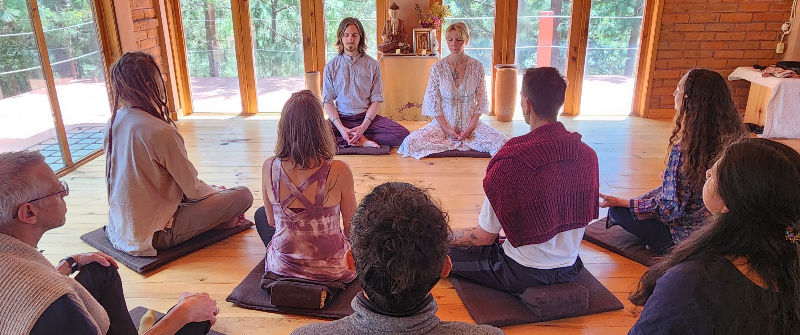
The alarm goes off before sunrise. The air in Chiapas at 2,200 metres is chilly at six in the morning, sometimes enough that you can see your breath inside the room. You pull on layers, splash water on your face, and walk to the heated practice hall in the dark.
This is how twenty-eight consecutive days begin.
For more on what the setting in San Cristóbal specifically contributes to the training — the altitude, the forest, the distance from ordinary life — that post covers the geography in detail.
By week three, the walk to the practice hall has stopped requiring any decision. You go because the day begins that way, because the body has adjusted to this rhythm, and because the alternative, lying in bed while the rest of the group sits, feels like a waste of an amazing opportunity.
That shift, from effort to habit to something closer to natural motion, is one of the quieter transformations the training produces.
To stay informed about dates of trainings including a forth coming 300HR advanced YTTC, Join the TTC waitlist.
What the Morning Practice Actually Is
The first session of the day is meditative Hatha Yoga, and it is not like a yoga class.
The pace is slower than most people expect. Poses are held long enough for the initial sensation to pass and for something subtler to become available. The emphasis is not on alignment in the architectural sense but on the alignment or integration of attention, the blow of breath and the sensation of the body, developing sensitivity: to the breath moving through the body, to where the attention naturally goes, to the difference between pushing through resistance and genuinely meeting it.
For participants accustomed to flow classes or physically demanding practice, the first week can feel like an exercise in frustration. The body wants to move faster. The mind wants more stimulation. The instruction does not accommodate this. By week two, most people understand why.
What the slow practice is training is not flexibility or strength, though both develop. It is the capacity to be present with direct experience without immediately reaching for the next thing. The invitation is to drop below the incessant narration of experience and into the direct immediacy of experience itself. As a yoga practitioner and especially an instructor, this is the foundational skill. You cannot teach embodied awareness if you do not know what it feels like to sustain it. Yoga, or any spiritual practice for that matter, can produce little transformation without this.
Each morning practice may include pranayama (breath based practices) and always end with seated meditation. Once a week there will be a pranayama/breathwork workshop taught in the morning session.
Philosophy After Breakfast
After breakfast, there is a teaching session.
This is where the texts come in. We work through primary sources from the Hatha and Tantrik traditions: the Hatha Pradipika, Amritasiddhi, selections from the Vijnanabhairava Tantra, passages from the Kashmir Shaiva philosophical literature. Not as historical survey, but as living material with direct application to what was just practised an hour earlier.
The discussion is not academic. Someone will raise something that happened in their sitting that morning. The text provides a frame for understanding it that goes beyond personal interpretation. The frame gets tested against direct experience, modified, refined.
Over four weeks, this back-and-forth between practice and study produces something that neither could produce alone.
We'll also explore a range of fundamental topics for a yoga teacher, everything from surrender and the principle of karma, to teaching methodology and basic approaches to marketing should you decide to go into teaching.
Anatomy Through the Body, Not a Slide Deck
Anatomy instruction runs through the training in a way that is worth describing specifically because it differs from every other yoga teacher training we are aware of.
A portion of the anatomy curriculum is delivered through Thai massage. Participants work in pairs, learning the lines of the body by moving through them with their hands, locating tension and release by feel rather than by diagram. The knee joint, which every yoga training covers in theory, becomes something you actually understand through the sensation of working with it.
The slide deck still exists. But by the time you see it, you have already met what it is describing. These sessions are taught by facilitator Venus Ray, who works as a Thai massage therapist and regularly hosts Thai massage trainings.
The Afternoon and What the Hours Between Sessions Do
After the midday meal there is a rest period, followed by an afternoon session that might be pranayama practice, teaching methodology, subtle body study, or practicum, where participants begin preparing and delivering material to the group.
The practicum sessions are uncomfortable in the way that most useful things are. Standing in front of a small group and attempting to teach what you have been practising for three weeks reveals, efficiently and without mercy, the gap between knowing something and being able to communicate it. This gap is the actual subject of the afternoon sessions, more than any specific content.
Every Friday there is a cacao ceremony, another unique contribution from Venus, in which there will be time to sing, to pray and a little later, to dive into a juicy discussion on spiritual topics.
On Sundays there will be morning practice followed by free time for study, rest and social connection. This is not a small detail. The free time is where integration happens. Where the week's material becomes something you have actually absorbed rather than something you are currently holding onto. By week three, most participants find they do not know what to do with free time. The rhythm of the week has become the natural state.
The Evening Tantrik Practice, Study Groups & Sharing Circles
The evening sessions vary. Some are guided Tantrik meditation, working with the specific practices of the Non-Dual Shaiva tradition: mantra, visualisation, and the somatic meditations that form the heart of the approach.
Some evenings will be dedicated to study groups, for student lead discussions and exploration of the material presented. Some evenings there will be sharing circles, which provide necessary space to de-compress and self reflect.
These are not additions to the yoga curriculum. They are expressions of the same understanding in a different cultural register. The thread that connects the morning Hatha practice, the philosophy session, and the cacao ceremony is the same: the investigation of what you are, conducted through every dimension of embodied experience.
For more on the Tantrik framework behind the training and what it adds philosophically to a standard 200-hour curriculum, that post covers the lineage and its practical implications.
By the end of twenty-eight days, this is not an idea. It is a lived rhythm.
What the Training Produces
A completed RYS 200-hour yoga instructor certification, registered with Yoga Alliance, qualifying you for the RYT 200 designation.
Also something harder to put on a CV. A working relationship with a daily practice that has been tested under conditions of genuine immersion. A philosophical foundation in traditions most yoga teachers have not read. A body that has practised seriously, repeatedly, under guidance, for nearly a month.
Many students who complete the teacher training return for a silent meditation retreat at Hridaya Family to consolidate what the training opened.
Full details of the curriculum, the two 2027 cohorts, and how to apply are on the Embodied Awakening YTTC page. If you want to speak with Kyle directly before deciding, reach us via WhatsApp.
Frequently Asked Questions
What is the daily schedule in hours?
The training provides nine or more hours of scheduled content Monday through Saturday, with Sunday mornings free. This includes morning practice, teaching sessions, anatomy, philosophy, practicum, and evening sessions. Total contact hours exceed 200 over the 28 days.
Is previous yoga experience required for this yoga instructor certification?
Genuine personal practice is required. Formal teaching experience is not. We ask that you have practised long enough to have encountered something in yoga beyond the physical benefits, and we speak with every applicant before accepting them.
What is included in the cost?
The program is all-inclusive: tuition, 28 nights accommodation, and three vegetarian meals per day. Current pricing is on the YTTC page.
Are the 2027 cohorts still open?
The March 2027 cohort is currently accepting applications. The November 2027 cohort has a waitlist. Both have limited places. Visit the YTTC page to apply or join the waitlist.
How is this training different from other yoga teacher trainings?
We cover this directly in Why Most Yoga Teacher Trainings Don't Actually Teach Yoga.
By day twenty-eight, the walk to the practice hall in the dark no longer requires the alarm to make sense.
What you do with that after you leave is the part that matters.


Comments