
Silent Meditation Retreat in Mexico: Everything You Need to Know


Most people picturing a meditation retreat in Mexico picture the coast. Tulum, maybe, or somewhere hot, with a pool and a view of the Caribbean. Clean, photogenic, expensive.
San Cristóbal de las Casas is none of those things.
It sits at 2,200 metres above sea level in the highlands of Chiapas, surrounded by pine forest and mountain valleys, in the same region where Tzotzil and Tzeltal Mayan communities have maintained their spiritual traditions without interruption for centuries. The mornings are cold. The fog moves through the valley in a way that makes everything feel slightly out of time. The town itself is colonial, cobblestoned, genuinely indigenous in character rather than aesthetically indigenous in the way resort towns tend to be.
It is, in our experience, one of the most naturally conducive places for deep meditation practice that we have encountered. Not because it is dramatic or beautiful, though it is both. Because it is quiet in a way that goes deeper than the absence of noise.
Learn more about this beautiful part of Mexico
Why Location Matters More Than People Expect for a Silent Meditation Retreat
The quality of a silent meditation retreat is not determined solely by the teaching or the schedule. Of course your participation and commitment matter the most. However the environment itself contributes massively.
A retreat centre surrounded by city traffic, airport approaches, or the particular kind of ambient anxiety that accumulates in tourist destinations produces a different container than one embedded in genuine remoteness and natural stillness.

Chiapas has a specific quality that long-term practitioners tend to notice. The land here carries what the indigenous communities who have lived on it for generations would call the weight of ritual and prayer. We are cautious about how we describe that. But the effect on practice is observable, and it is worth naming honestly.
Our retreat centre is on a piece of land considered sacred by the Mayan elders of the local indigenous communities, who have maintained prayers for centuries for the protection of the land. Our good friend Carlos is a member of this community and joins us at the start of every retreat for a ritual cleansing and offering ceremony.
The altitude also plays a role. At 2,200 metres, sleep tends to deepen, the body slows down naturally, and the kind of forced mental busyness that characterises ordinary life becomes harder to maintain. This is not comfortable in the first day or two. After that, most people find it works for them rather than against them.
The crisp cool mountain air, the smell of the pine forest and the beautiful views available from nearly everywhere on the property certainly deserve a mention!
Find out more about our retreats here
The Hridaya Family Retreat Centre
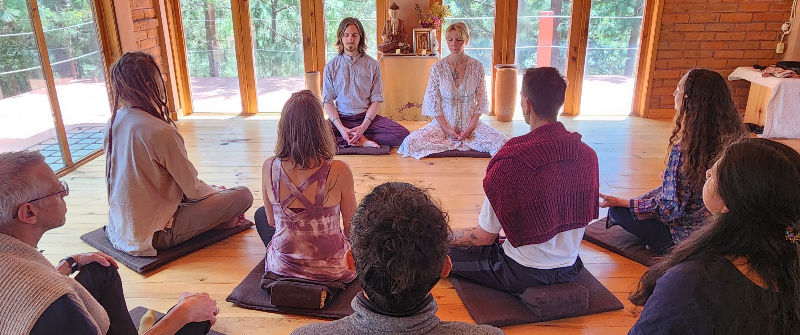
Our centre is a residential facility in San Cristóbal designed specifically for group and individual retreat practice. Rooms are simple and private. Meals are vegetarian, prepared daily, and served in silence. The schedule is structured and consistent, which matters more than most people realise going in: knowing what comes next removes a layer of low-level mental negotiation that can occupy more attention than it seems to.
The group retreats we run are rooted in the tradition of Non-Dual Shaiva Tantra and the practice of Self-Inquiry meditation as taught through the Hridaya lineage. The practice is not technique-heavy. It is oriented around learning to recognise the presence of awareness directly, through sustained sitting, guided sessions, and the accumulated effect of extended silence.
We also offer solitary retreats for practitioners who want extended individual practice without the group container. These are available on request and are suited to people with prior retreat experience.
What a Silent Meditation Retreat in Chiapas Actually Looks Like
A typical day in one of our group silent retreats begins early. Morning meditation before breakfast, followed by a guided session with the teacher, then periods of individual practice, meals taken in silence, and an evening session before rest. The schedule is full without being rushed. There is enough structure to prevent the mind from filling the day with its own agenda, and enough space for the practice to actually open up.
The silence is maintained throughout. No conversation except with the teaching staff when necessary. No phones, no reading, no writing during the retreat itself. The point of all of this is not asceticism. It is the removal of the inputs that ordinarily keep the mind occupied so that something quieter can be heard.
Getting to San Cristóbal de las Casas
The nearest airport is in Tuxtla Gutiérrez, roughly an hour and a half from San Cristóbal by road. There are direct flights from Mexico City and connections from most major international hubs. The drive from the airport to San Cristóbal passes through the Sumidero Canyon, which is worth noting not as a tourist observation but because it sets the register of the place before you arrive.
Alternatively, overnight buses run directly from Mexico City and other major cities. The journey is long but comfortable and deposits you in the centre of town.
We recommend arriving the day before your retreat begins. The altitude adjustment is real and arriving already tired makes the first day harder than it needs to be.
Frequently Asked Questions
Are your silent meditation retreats in Mexico suitable for beginners?
Yes. We ask that people come with genuine interest in the practice, but no prior meditation experience is required. We speak with everyone before they book to make sure the retreat is a good fit for where they are.
How long are the silent retreats?
We offer three-day, seven-day, and ten-day formats. For most people beginning retreat practice, three to seven days is a sensible starting point. The ten-day retreat allows for a depth that shorter formats do not fully reach. You can read more in What Is a 10-Day Silent Meditation Retreat Really Like?
Is Spanish required?
No. Our retreats are conducted in English. Some of our retreats are offered in Spanish as well. If language is a concern, contact us directly and we will clarify what is available.
How does a silent retreat differ from a darkness retreat?
A silent retreat removes social interaction and external stimulation while keeping full sensory access. A darkness retreat removes visual input entirely, placing you in complete darkness for several days. Both are forms of deep retreat practice. The silence retreat is typically where people begin.
How do I book?
Current retreat dates are listed on our events calendar. To speak with us before booking, reach out via WhatsApp. Kyle speaks personally with everyone.
The coast has its uses. For serious practice, we have found the mountains more honest.
If San Cristóbal feels like the right setting, we would like to hear from you.


Comments