
What Is a 200-Hour Yoga Teacher Training? A Complete Guide

Updated: Jun 19

Two hundred hours sounds specific. It implies a standard. It does not deliver one.
The 200-hour yoga teacher training is the entry-level certification recognised by Yoga Alliance, the largest international registry for yoga teachers and schools. Completing a registered 200-hour program qualifies you to register as an RYT 200, which is the credential most studios, platforms, and retreat centres ask for when hiring teachers.
That much is consistent.
What happens inside those two hundred hours is not.
What the Number Actually Means
Yoga Alliance requires that registered schools deliver a minimum of 200 contact hours across a set of curriculum categories: techniques and practice, teaching methodology, anatomy, yoga philosophy, and professional essentials. The minimum contact hours in each category are specified. Everything beyond the minimum is at the school's discretion.
The result is that two programs can both be legitimately called a 200-hour yoga teacher training while looking almost nothing alike. One might run over ten weekends across six months with six hours of contact per day. Another might be a 28-day residential immersion with nine or more hours of direct instruction daily. The credential at the end carries the same name. What the student actually absorbed, practised, and understood is a different matter entirely.
This is not a criticism of Yoga Alliance. Regulatory minimums serve a purpose. The problem is when the number is treated as a quality guarantee rather than a floor.
What Varies Between Programs
The most significant variable is not the content categories but the density and depth of daily practice.
A training that provides 6.5 hours of scheduled content per day across 21 days produces a fundamentally different kind of learning than one that provides 9 or more hours across 28 days. Not because more hours means more information transmitted, but because immersion works differently than attendance. The body needs time to absorb what it is learning. The nervous system needs repetition. The kind of understanding that changes how you actually teach comes from doing the same thing over and over in different registers until it becomes lived rather than known.
In fact it is commonly the case that a 200HR teacher training will include much less than 200 hours of class time. You are expected to make up the hours with supplementary online classes and/or self assessed classes that you teach, often to friends and family, once the training is over.
If you think about it briefly, 200 hours would be 10 hours per day for 20 days. Most of the teacher training courses out there are less than 20 days long and have less than 10 hours of classes per day.
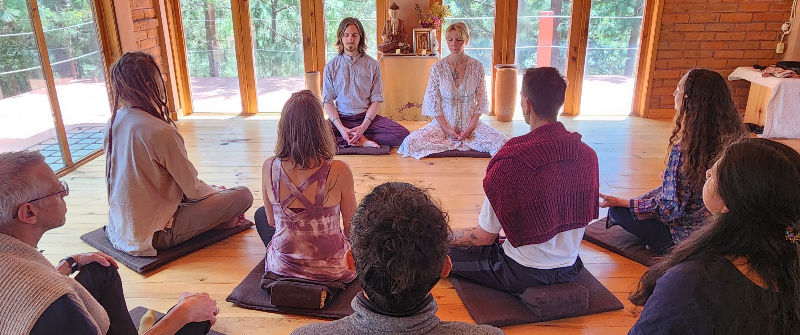
Our Embodied Awakening Yoga and Embodiment Teacher Training includes more than 200 hours of face to face class time with the trainers Kyle, Sasha and Venus.
Philosophy and history are the other major variable. Most 200-hour trainings cover yoga philosophy through a very basic glance over the econd chapter of the Yoga Sutras of Patanjali and occasional references to the Bhagavad Gita. These are important texts. They are also not the whole picture, and in many programs they receive a few hours of overview rather than sustained engagement with primary sources. The Tantrik texts that carry much of the most sophisticated thinking in the broader yogic tradition barely appear at all.
For more on what a Tantrik framework adds to teacher training beyond what standard curricula cover, that post goes into the specific differences.
Anatomy is typically covered through classroom instruction. A smaller number of programs integrate it experientially, through hands-on bodywork, Thai massage, or somatic practice, which produces a qualitatively different kind of anatomical understanding than a slide presentation.

What the Hours Should Actually Do to You
The practical question behind all of this is not whether you can complete 200 hours. It is whether those hours change something in how you understand and inhabit your own practice.
A yoga teacher who finishes their training and immediately sets up a class schedule has learned to teach. A yoga teacher who finishes their training and finds that the practice itself looks different, feels different, asks more of them than it did before has been educated. The credential is the same. The capacity is not.
What produces the second outcome is not a particular curriculum or a particular teacher. It is sustained immersion with material that is genuinely demanding, delivered in an environment that removes the ordinary distractions, and held by people who take the tradition seriously enough to teach it as a living thing rather than a subject to be covered.
In all honesty, we consider a 200HR training more of an initiation into profound practice than a complete teaching qualification. Indeed the majority of people who take 200HR trainings do so in order to deepen their practice. Those who eventually become serious about wnating to teach usually consider a follow-up 300HR training course, intended to deepen the knowledge and practice imparted in a basic 200HR training. These 2 together equal a RYT-500 qualification (by Yoga Alliance standards).
If you're interested to know more about our forthcoming 300HR trainings join this mailing list specifically for our teacher training courses
What to Look For When Comparing Programs
A few honest questions worth asking any training you are considering.
How many hours of daily practice are included, not just scheduled instruction? What primary texts are studied, and how deeply? Is the training residential, and if so, what does the daily container actually look like? What is the teaching team's own practice history, not their credentials on paper but what they have actually done and for how long?
The answers will tell you more than the brochure will.
For a direct account of why most programs fall short of actually teaching yoga, and what to look for instead, that post covers it plainly.
How Our Training Is Structured
Our 200-hour yoga teacher training at Hridaya Family in San Cristóbal de las Casas, Mexico runs over 28 days, fully residential, with more than 200 hours of direct instruction and up to 4.5 hours of daily practice. The curriculum draws from the Hatha Yoga texts, the Tantrik tradition, and the Non-Dual Shaiva philosophy that underpins our approach to both practice and teaching.
For a concrete picture of what a typical day looks like in a 28-day immersion, that post goes hour by hour through the schedule.
It is a Yoga Alliance registered program. The certification at the end is the same credential you would earn anywhere else. What leads to it is not.
Full details of the curriculum, dates, and how to apply are on the Embodied Awakening YTTC page.
Full details of our 200-hour yoga teacher training in Chiapas, including dates, curriculum, and pricing, are on the training page.
Frequently Asked Questions
Is a 200-hour yoga teacher training enough to teach professionally?
The RYT 200 is the standard entry-level credential that most professional contexts require. It is enough to begin teaching. Whether it is enough to teach well depends entirely on what the training actually covered and how seriously you continue your own practice afterward.
What comes after a 200-hour yoga teacher training?
The next formal step is a 300-hour advanced training, which qualifies you for the RYT 500 designation. At Hridaya Family we are developing a 300-hour program for practitioners who have completed our 200-hour course. Beyond formal credentials, the more significant development happens through sustained personal practice, solitary retreat, and continued study with teachers whose depth you trust.
Can I do a 200-hour yoga teacher training online?
Online formats exist and are Yoga Alliance registrable under updated guidelines. The trade-off is the absence of residential immersion, which, for the reasons described above, matters. An online format can transmit information. It cannot replicate what happens when a group of people practise together in the same space for four weeks.
How much does a 200-hour yoga teacher training cost?
Costs vary significantly. Our program is all-inclusive: tuition, 28 nights accommodation, and three meals per day are covered in a single fee. For current pricing and available dates, visit the YTTC page or reach us directly via WhatsApp.
Do I need prior teaching experience to apply?
No. We ask that you have a genuine personal practice and that you are coming to the training with real interest in understanding the tradition, not just acquiring a certification. We speak with every applicant personally before accepting them.
Two hundred hours is enough time to begin to understand what yoga is.
Whether it is used that way depends on what fills them.

Comments